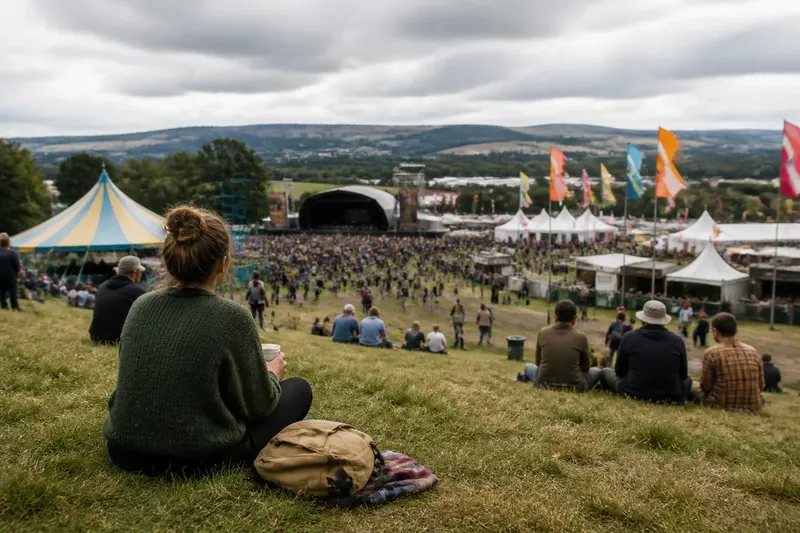
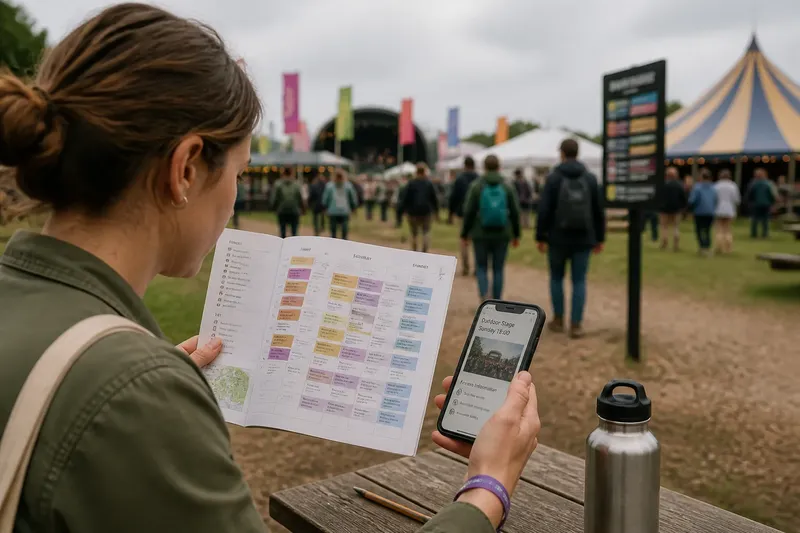
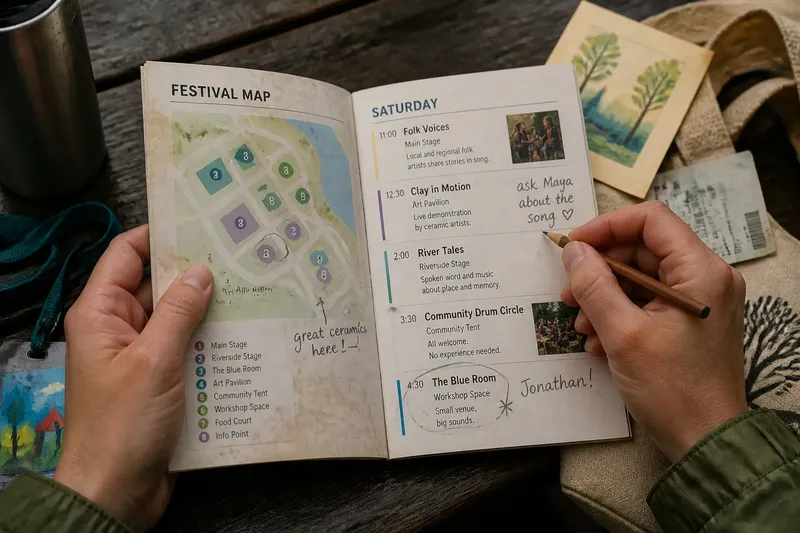
A First Loop Around an Unfamiliar Festival Site
A first loop around an unfamiliar festival site helps you spot entrances, meeting points, program information, and useful routes before choosing where to settle.
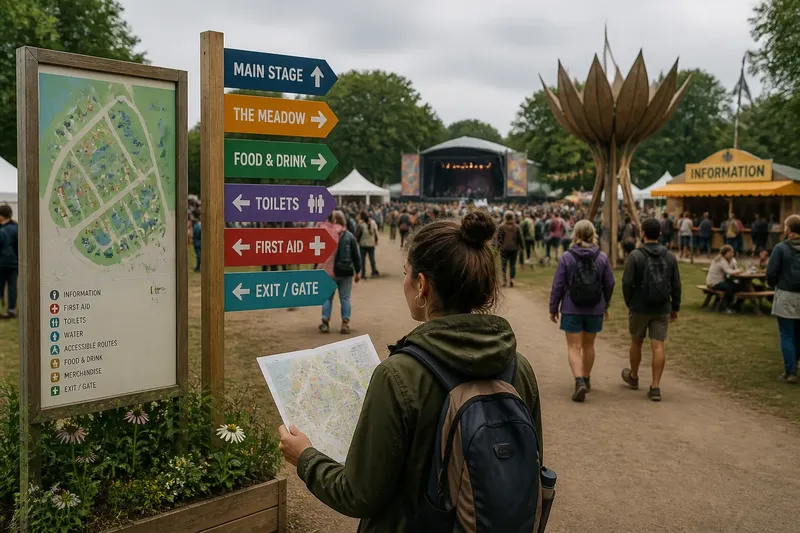
A first loop around an unfamiliar festival site is more useful than picking a stage from the entrance and heading straight there. A slow circuit reveals how the grounds connect, where people can regroup, and which information is actually easy to reach. The aim is not to memorize the whole place; it is to make the next choice with a workable sense of direction.
Start with the edges
Say you arrive at a hypothetical festival in a park you have never visited. The entrance opens onto a broad path, with music audible from somewhere beyond a row of trees. Rather than following the sound immediately, you pause just clear of the gate and look for the site map, posted schedule, and any signs marking exits or visitor services.
That first pause matters because the entrance is a reference point you can return to. Notice its sign, nearby landmarks, and the path leading back to it. If the site has several gates, check whether they lead to different streets or transit stops; a gate that looks close on the map may not be the one you used to arrive.
Keep the first circuit on public paths and follow staff directions. You are looking for the shape of the site, not for a shortcut through a production area or a line that appears to be moving. A festival ground is less like a blank page than a house with several doors: knowing which door you came through is already useful.
Mark useful anchors
As you walk, identify a few places that would be easy to describe to another person. A large sculpture, a distinctive food kiosk, a main information booth, or a prominent path junction works better than “near the blue tent” if several tents are blue. Choose landmarks that remain visible from more than one direction.
Look for likely gathering points, such as a staffed information area or a broad, clearly signed meeting place. A useful meeting point is easy to locate, not directly in a narrow flow of foot traffic, and recognizable without relying on a phone signal. If you are attending with others, agree on a specific landmark rather than a vague area.
Notice practical services as part of the same circuit: restrooms, water stations, accessible routes, first aid, and places to sit. Their locations may matter more later than the name of a small stage. Where a service is not obvious, check the map or ask staff instead of assuming that a cluster of tents marks it.
Read the site, not just the map
A printed map or posted plan gives you the intended layout; the grounds show how that layout works in practice. Watch for paths that narrow, fences that redirect movement, and visible queues that spill across junctions. These details can change which route feels straightforward, even when two destinations look close together on paper.
Check the program information where it is posted, but treat the first circuit as orientation rather than a scheduling session. Notice whether stage names on the signs match the names on the map, and whether there is a central place to check updates. If a sign is missing or unclear, the information booth is a better source than following a crowd and hoping it is headed somewhere relevant.
Pay attention to the sound and sightlines, too. One stage may be audible across a large stretch of the grounds, while another sits behind a screen or building. That gives you a rough sense of where you can pause without blocking a route and where a performance area may be busy.
Choose a first base
After the circuit, pick a place to settle based on what you now know: a nearby performance, shade, seating, food, or a convenient route between areas. A “base” need not be a reserved spot. It can simply be a recognizable area you expect to return to, with a clear path from a landmark.
In the hypothetical park, the arrival path leads to a junction beside the information booth. The visitor notices that one branch reaches a small stage while another passes restrooms and a shaded seating area. They choose to pause near the seating area, then use the booth and a distinctive sculpture as reference points when heading toward the stage. The expected result is not a perfectly optimized day; it is a first move that does not depend on guessing where the paths lead.
Keep the plan provisional. If a crowd thickens or a route closes, return to a known junction and choose another signed path. A simple mental map—entrance, meeting point, one service area, and the first destination—is often enough to make later changes feel manageable.
Questions at arrival?
How long should a first loop take?
Take enough time to identify the entrance, main junctions, meeting point, and essential services without turning the walk into a tour of every corner. The right length depends on the site and your needs; stop once you can explain how to return to your starting point and reach your first destination.
Should I follow the crowd to find a stage?
A crowd can indicate where activity is happening, but it does not confirm which performance or entrance it leads to. Check stage signs or posted program information before joining a dense flow, especially near a junction.
What if the map and signs disagree?
Use the nearest official information point or ask event staff for current directions. Site changes can make a displayed plan less useful in one area, and guessing from an outdated sign can send you back the way you came.
Where should a group meet if someone gets separated?
Choose one distinctive, clearly accessible landmark and state it plainly, including which side or entrance you mean. Avoid a busy gate or narrow path where people would have to stand in the way to look for one another.
Keep the map simple
Before leaving the first circuit, mentally connect only the places you are likely to need: your entrance, a meeting point, one service area, and the route to your chosen starting spot. You can add more landmarks as the day unfolds. A first loop around an unfamiliar festival site works best when it leaves you oriented enough to enjoy the next decision, not burdened with a diagram of the entire grounds.
Where venue access, services, or routes depend on posted instructions or local rules, follow the current signs and staff guidance. One final practical detail: make sure everyone in your group knows the agreed meeting point before you separate, while the landmarks are still fresh in mind.